

We’re creating a future where more people can explore technical careers, develop practical skills, and participate in an industry that continues to shape how the world works. But with major technology companies announcing layoffs and restructuring, many people are beginning to question whether pursuing a career in technology is still a smart decision.
Recent headlines have made that concern understandable. In November 2026, Canva announced a major restructuring affecting 1,271 employees, representing approximately 22% of its workforce. The changes include layoffs, role changes, and relocation as the company reorganizes its teams following a slowdown in growth.
For someone considering a career change, entering the workforce, or investing in technical education, news like this can be discouraging.
Does this mean technology careers are becoming less valuable? Are companies hiring fewer technical professionals? And more importantly, is it still worth spending time learning skills such as programming, networking, and cybersecurity?
The answer requires looking beyond individual company announcements. Technology is changing, and the skills employers need are changing with it. Understanding these changes can help prospective students make more informed decisions about their career paths.
Why Are Technology Companies Laying Off Employees?
Technology layoffs happen for different reasons. A company reducing its workforce does not necessarily mean the entire technology industry is declining.
Businesses regularly review their operations, expenses, organizational structures, and workforce requirements. When their priorities change, some positions may be eliminated, combined, or redesigned.
Several factors can contribute to technology industry layoffs.
1. Business restructuring and cost reduction
Companies may reorganize departments, remove overlapping responsibilities, or reduce management layers to improve efficiency.
For example, Canva’s November 2026 announcement involved combining its Product, Growth, and Platform teams into one organization. The restructuring was intended to simplify operations and give teams clearer responsibilities.
2. Changes in technology and automation
Artificial intelligence and automation are changing how businesses complete certain tasks.
Some routine activities can now be completed with fewer manual steps. This encourages companies to reconsider how work is distributed and which skills their employees need.
However, it is important not to assume that every technology layoff is caused by AI. Business performance, operating costs, competition, and organizational changes can also influence workforce decisions.
3. Changing business priorities
Companies may redirect their investments toward new products, services, or technologies.
As a result, certain roles may become less important while other technical capabilities receive greater attention.
These developments show why understanding the industry matters. A career decision should not be based on one company’s restructuring announcement alone.
Does This Mean Technology Careers Are Disappearing?
No. Technology careers are not limited to working for large software companies or well-known technology brands.
Businesses across healthcare, education, manufacturing, finance, construction, and other industries depend on technology to operate.
They need professionals who can maintain systems, solve technical problems, manage networks, develop software, and protect important information.
Some technology career areas include:
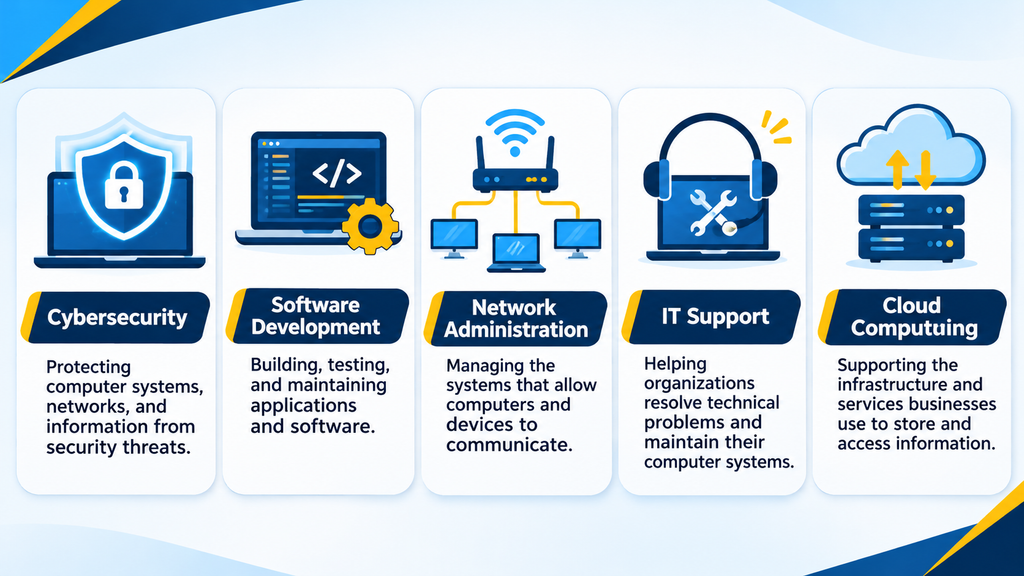
Each field has different responsibilities, qualifications, and skill requirements.
For example, someone interested in cybersecurity may need to understand networking, security monitoring, and incident response.
The important distinction is that technology offers multiple career pathways. A slowdown at one company does not automatically eliminate opportunities across every technical field.
Which Technical Skills Are Worth Developing Today?
One of the most practical responses to changes in the technology industry is to focus on developing relevant, transferable technical skills.
Transferable skills are abilities that can be applied across different roles, organizations, and work environments.
Rather than focusing exclusively on a particular job title, prospective students should consider what technical knowledge will help them solve real workplace problems.
Here are several areas worth exploring.
1. Networking Fundamentals
Networking is the foundation of how computers and devices communicate.
Understanding networks helps technical professionals work with connected systems, identify communication problems, and understand how information moves between devices.
Foundational networking knowledge is particularly useful for people considering IT support, network administration, and cybersecurity.
2. Cybersecurity Fundamentals
Cybersecurity involves protecting systems, networks, and information against unauthorized access, attacks, and other security risks.
Organizations need to understand potential threats and develop processes for identifying and responding to security incidents.
Learning cybersecurity fundamentals introduces students to areas such as security monitoring, threat identification, risk management, and incident response.
3. Python Programming
Python is a programming language used in automation, data processing, scripting, and technical problem-solving.
In cybersecurity, Python can help professionals automate repetitive tasks, work with information, and develop tools that support security-related activities.
Students do not necessarily need to become professional software developers to benefit from learning basic programming concepts.
4. BASH and PowerShell
BASH and PowerShell are command-line tools used to interact with computer systems and automate administrative tasks.
Learning these tools helps students understand how technical professionals manage systems, execute commands, and perform routine operations.
5. Technical Documentation and Problem-Solving
Technical work involves more than knowing how to use software or write code.
Professionals must also communicate what they discover, document their actions, and explain how problems were addressed.
Important workplace skills include:
- Clear written communication.
- Analytical thinking.
- Attention to detail.
- Teamwork and collaboration.
- Ethical decision-making.
- Accurate technical documentation.
These abilities help technical professionals work effectively with colleagues, supervisors, and other departments.
Why Is Cybersecurity One Technology Career Worth Exploring?
Cybersecurity is an area worth understanding because organizations increasingly depend on connected systems and digital information.
As businesses use technology to manage operations, communicate with customers, and store important records, protecting those systems becomes an important responsibility.
But what does a cybersecurity professional actually do?
Cybersecurity professionals work in different roles, depending on their experience and specialization. Their responsibilities may include monitoring security alerts, investigating suspicious activities, reviewing system information, documenting incidents, and helping organizations respond to potential threats.
For example, consider what happens when a security monitoring system identifies unusual activity.
What Happens When a Security Threat Is Detected?
A typical security incident workflow can involve several steps:
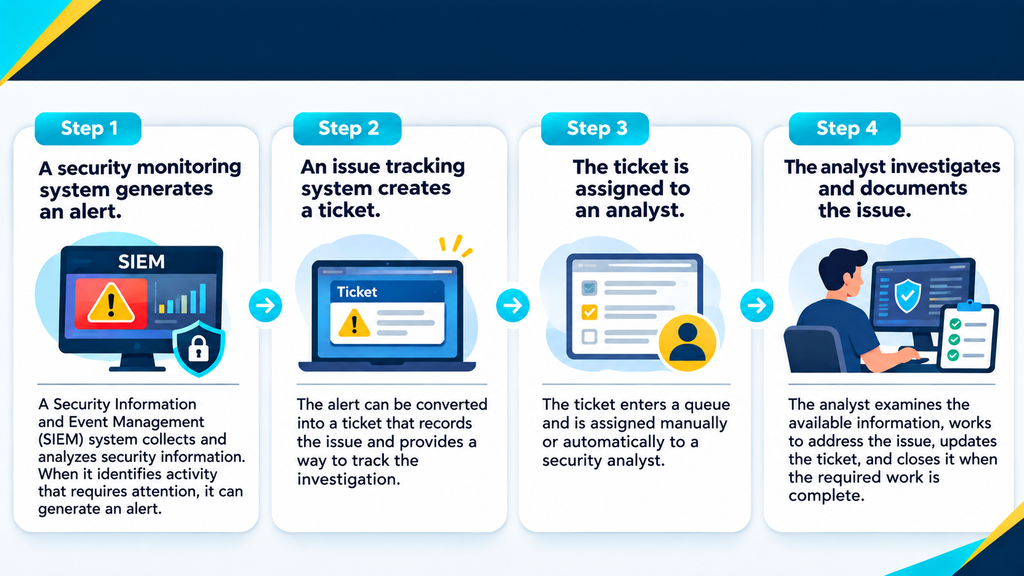
This process demonstrates why cybersecurity involves more than identifying threats.
Analysts must also manage their workload, maintain accurate records, communicate findings, and follow established procedures.
Ticketing systems are particularly important because they help organizations track cases and preserve information that may be useful for future investigations.
Understanding this workflow gives prospective students a clearer picture of the practical responsibilities involved in cybersecurity work.
How RW2 Career & Technical Education Helps Students Build Technical Skills
For people interested in exploring technology, having a structured learning environment can make the process easier to navigate.
RW2 Career & Technical Education is a nonprofit workforce training organization offering technical education in areas including cybersecurity, information technology, CADD, and Building Information Modeling (BIM).
Its cybersecurity training focuses on helping students develop foundational knowledge and practical technical skills.
The 24-week instructor-led program includes 456 instructional hours and incorporates several areas of technical learning.
Students explore:
- Networking and cybersecurity fundamentals.
- Security+ preparation and ISC2 Certified in Cybersecurity (CC) concepts.
- Python programming and hands-on projects.
- BASH and PowerShell scripting.
- Security monitoring and incident management.
- Technical problem-solving and documentation.
- Ticketing systems and case management.
- Capstone activities.
The program also incorporates practical learning opportunities through RW2’s Cyber Conversations work-based learning activities.
These experiences help connect classroom learning with the types of processes and responsibilities students may encounter in technical environments. For someone beginning a technology career, developing these skills can provide a foundation for continued learning, certification preparation, and exploration of potential career pathways.
The goal is not simply to complete a course. It is to help learners understand technical concepts, apply their knowledge, and build confidence as they prepare for future opportunities.
So, Is It Still Worth Pursuing a Career in Technology?
Technology layoffs are a reminder that no industry or position comes with guaranteed job security.
However, they should not be the only factor influencing your decision to pursue a technical career.
Technology continues to play an important role in how organizations operate, communicate, and protect information. Different industries require different technical capabilities, and the skills associated with these roles continue to develop.
For people considering this path, the more useful questions are:
- Which technical field interests me?
- What skills do employers expect in that field?
- What foundational knowledge do I need?
- How can I gain practical experience?
- What training opportunities can help me prepare?
A technology career requires ongoing learning, patience, and a willingness to adapt. You do not need to understand everything before getting started. What matters is having a clear learning direction and taking practical steps toward developing the skills your chosen field requires.
The industry may look different in the coming years, but learning how technology works and how to solve technical problems can remain valuable investments in your professional development.
Frequently Asked Questions
1. Is technology still a good career choice in 2026?
Technology can still be a worthwhile career choice in 2026. Organizations across different industries depend on technical systems, software, networks, and cybersecurity. However, career opportunities vary by specialization, employer requirements, and experience.
2. Do technology layoffs mean there are no jobs in IT?
No. Layoffs at individual companies do not mean that all IT positions are disappearing. Businesses continue to require professionals who can maintain systems, provide technical support, manage networks, and protect digital information. Job availability depends on the specific role and labor market.
3. Is cybersecurity a good career to consider?
Cybersecurity is worth exploring for people interested in computer systems, problem-solving, and protecting information. It includes different career paths, such as security analysis, incident response, and security operations. Each position has its own technical and experience requirements.
4. Can I learn cybersecurity without an IT background?
Yes. Beginners can start by learning computer fundamentals, networking, and basic security concepts. Structured training, instructor guidance, and practical exercises can help build the foundational knowledge needed to continue learning cybersecurity.
5. Do I need to know programming to study cybersecurity?
Not necessarily before starting. However, learning programming languages such as Python and scripting tools such as BASH and PowerShell can help develop technical problem-solving and automation skills. Their importance depends on the cybersecurity role you want to pursue.
6. Are cybersecurity certifications enough to get a job?
Certifications can demonstrate knowledge and help candidates meet certain employer requirements. However, they do not guarantee employment. Employers may also evaluate practical experience, technical abilities, communication, and other qualifications.
7. How long does it take to complete cybersecurity training at RW2?
RW2’s cybersecurity program is a 24-week, instructor-led training program consisting of 456 instructional hours. It includes foundational cybersecurity concepts, Python, scripting, hands-on exercises, and certification preparation.
Explore Your Next Step in Technology
We’re creating a future where people can explore technical careers, develop practical abilities, and find opportunities to contribute their skills. The technology industry will continue to change, and preparing for that future begins with understanding what different career paths require.
Whether you are considering cybersecurity, information technology, CADD, or BIM, taking time to learn about the field is a worthwhile first step. At RW2 Career & Technical Education, learners can explore structured technical training, instructor-led learning, hands-on activities, and career preparation.
You do not have to have your entire career figured out before you begin. Start by asking questions, exploring your interests, and identifying the skills you want to develop. Your next opportunity may begin with what you choose to learn today.
Could cybersecurity be your next career path? RW2’s next cybersecurity training cohort begins December 14. Take this opportunity to learn more about the program and what it offers. Complete the RW2 General Interest Form, and the RW2 team can connect with you to discuss the training and your next steps.