We’re creating a future where people can continue to learn, adapt, and build meaningful careers as technology changes the way work gets done. AI and the future of work are already closely connected, and a recent prediction from Elon Musk has renewed the conversation about how quickly that future could arrive.
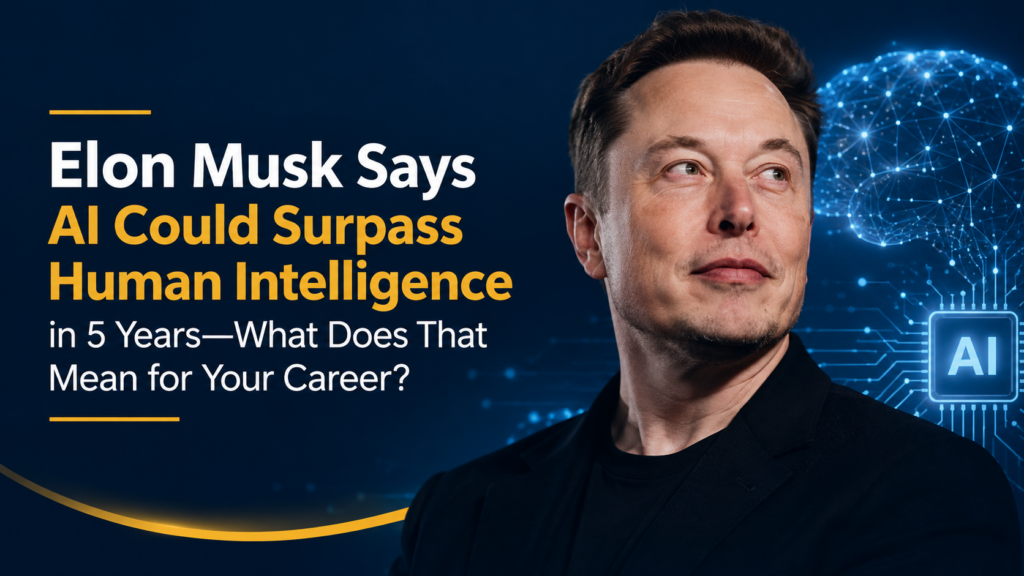
Speaking at the World Economic Forum in January 2026, Musk said AI could become smarter than any individual human as early as the end of 2026 or the following year. He then suggested that by around 2030 or 2031, AI could become smarter than humanity collectively. In a July 2026 interview with The Economist, he made a similar prediction, saying AI could exceed the combined intelligence of humans in roughly five years.
Musk’s timeline is a prediction, not a certainty. But it raises a practical question for anyone thinking about their career:
How should you prepare for a workforce where AI becomes part of more jobs?
The answer is not necessarily to avoid AI. It is to understand how technology is changing work and build skills that remain valuable as those changes happen.
What Does AI Mean for the Future of Work?
Artificial intelligence allows computer systems to perform tasks that traditionally require human intelligence, including analyzing information, recognizing patterns, generating content, solving problems, and assisting with decisions.
As AI becomes more capable, many jobs are likely to change rather than simply disappear.
The World Economic Forum’s Future of Jobs Report 2025 estimates that 170 million new jobs could be created globally by 2030 while 92 million jobs could be displaced. That would result in a projected net increase of 78 million jobs. The report also estimates that nearly 40% of the skills required on the job could change by 2030.
AI is already being used to:
- Analyze large amounts of information
- Automate repetitive tasks
- Create drafts and reports
- Identify patterns and potential problems
- Support research and decision-making
- Improve productivity
- Assist with technical design and development
But AI output still needs to be understood and evaluated by people with knowledge of the field.
For example, an AI design tool may generate an output, but a technical professional still needs to understand measurements, project requirements, and whether the result is accurate.
In cybersecurity, AI can help identify suspicious activity, but professionals still need to understand networks, threats, security controls, and risk.
The tools may change. Understanding the work remains essential.
Which Careers Are Likely to Grow as AI Changes Jobs?
The growth of AI does not mean everyone needs to become an AI engineer.
Many careers will use AI as one tool within a larger professional workflow. Technology-related fields are expected to remain important as organizations adopt more digital systems and automation.
The World Economic Forum identifies AI and machine learning specialists, big data specialists, and fintech engineers among the fastest-growing roles. It also expects demand for cybersecurity skills to grow significantly.
Other career areas worth watching include:
- Cybersecurity
- Artificial intelligence and machine learning
- Data analysis and data science
- Software development
- Cloud computing
- Information technology
- Engineering
- Digital design and technical drafting
- Building Information Modeling (BIM)
- Healthcare technology
- Technology project management
The U.S. Bureau of Labor Statistics projects 15% employment growth for software developers, quality assurance analysts, and testers from 2024 to 2034, much faster than the average for all occupations.
But career growth is not only about choosing a field with strong projections. Employers also need people who can solve problems, communicate clearly, work with others, and make sound decisions.
That combination of technical knowledge and human judgment is becoming increasingly important.
Why Is Cybersecurity Becoming More Important in an AI-Powered World?
Cybersecurity protects computers, networks, applications, systems, and data from unauthorized access, attacks, and other digital threats.
As organizations adopt more AI and digital technology, they also create more systems and information that need protection.
AI can help security teams detect patterns and respond to threats. At the same time, attackers can use advanced technology to create new threats. This creates a growing need for professionals who understand both technology and risk.
Cybersecurity professionals may need to answer questions such as:
- Who has access to sensitive information?
- Is the system configured securely?
- What happens if an account is compromised?
- How should suspicious activity be investigated?
- How should an organization respond to an attack?
- How can sensitive data be protected?
A cybersecurity career therefore requires more than learning software or memorizing security concepts.
Professionals need skills such as:
- Networking
- Threat identification
- Risk management
- Security monitoring
- Incident response
- System protection
- Basic programming
- Professional ethics
They also need to communicate effectively. A cybersecurity professional may have to explain a technical problem to a nontechnical manager, work with a team during an incident, or document what happened.
Technical ability gets you into the conversation. The ability to think, communicate, and solve problems helps you contribute.
How Can Lifelong Learning Prepare You for the Future of Work?
Technology does not stand still, and neither should your skills.
Lifelong learning does not necessarily mean returning to school every few years. It can mean continuing to build on your existing knowledge as your industry changes.
A practical approach is to:
1. Identify the direction of your industry.
Look at the technologies, certifications, and skills employers are requesting.
2. Build a strong foundation.
Focus on understanding the fundamentals of your chosen field rather than trying to learn every new tool at once.
3. Learn how AI affects your work.
You do not have to become an AI developer. Understanding how AI is being used in your profession can help you use new tools effectively.
4. Practice what you learn.
Projects and hands-on work help turn knowledge into usable skills.
5. Build evidence of your abilities.
A portfolio, certification, project, or work-based learning experience can help demonstrate your skills to employers.
For adult learners and career changers, this approach can be especially valuable. Your previous experience does not have to be left behind when you move into a technical field.
Communication, project experience, customer service, leadership, and problem-solving can complement new technical skills.
You may not need to start your career over. You may simply need to add a new skill set.
How Can RW2 Help Prepare Learners for the Future of Work?
Preparing for the future does not require knowing exactly what technology will look like five or ten years from now.
It starts with building skills that give you a strong foundation for what’s next.
RW2 Career & Technical Education provides career-focused training in areas including AEC, CADD, IT, and cybersecurity. Through online instruction, certification preparation, work-based learning, and career readiness support, RW2 helps learners build practical skills connected to technical careers.
Learners can focus on:
- Building technical knowledge
- Developing career-ready skills
- Preparing for industry-recognized certifications
- Creating work that demonstrates their abilities
- Strengthening communication and teamwork
- Building confidence through practice
- Preparing for workforce participation
For someone interested in cybersecurity, that can mean developing a foundation in protecting systems, identifying threats, and understanding security practices.
For someone interested in CADD or BIM, it can mean developing the technical knowledge needed to create, interpret, and manage digital design information.
The goal is not to predict which technology will dominate the next decade.
It is to help learners develop skills they can continue building on.
What Does Elon Musk’s AI Prediction Really Mean for Your Career?
Whether AI surpasses human intelligence within five years is impossible to know with certainty.
What is clear is that AI is already changing how people work.
So instead of asking whether AI will take your job, consider what you can do to remain useful as your industry changes.
You could:
- Build a technical skill in a growing field
- Learn how AI is being used in your industry
- Develop practical experience
- Earn relevant certifications
- Create a portfolio of your work
- Strengthen communication and problem-solving skills
You do not have to compete with AI at everything it can do.
You need to understand your work well enough to use technology, evaluate its results, solve problems, and make informed decisions.
That applies whether your career path leads to cybersecurity, CADD, BIM, IT, or another technical field.
Frequently Asked Questions About AI and the Future of Work
Q: Will AI replace most jobs in the next five years?
A: There is no reliable evidence that most jobs will disappear within five years. AI is expected to automate some tasks, change others, and contribute to new roles. The World Economic Forum projects both job creation and job displacement through 2030.
Q: What careers are likely to grow because of AI?
A: AI, data, software, cybersecurity, and other technology-related fields are expected to see continued demand. Technical fields such as engineering, CADD, and BIM will also continue evolving as organizations adopt new digital tools.
Q: Is cybersecurity a good career for the future?
A: Cybersecurity is an important career area because organizations increasingly depend on digital systems and need professionals who can protect information and technology. The field also requires problem-solving, communication, teamwork, and ethical decision-making.
Q: Do I need to become an AI expert to stay employable?
A: No. You do not need to become an AI researcher or developer. Building strong skills in your chosen field and understanding how AI affects that field can help you stay prepared.
Q: Can adults switch to a technical career?
A: Yes. Adult learners can develop technical skills while building on experience from previous careers. Skills such as communication, leadership, customer service, project management, and problem-solving can complement technical training.
Q: What skills will employers want in the future?
A: Employers are expected to value both technical and human skills. Technology knowledge, cybersecurity, AI and data skills, critical thinking, communication, flexibility, and collaboration can all contribute to career readiness.
Q: Why are soft skills important in technical careers?
A: Technical professionals work with people as well as technology. They may need to explain complex information, collaborate with teams, document problems, make decisions, and communicate solutions clearly.
Q: How can I start preparing for the future of work?
A: Start by identifying a technical career that interests you and researching the skills employers need. From there, consider focused training, practical projects, certifications, portfolio development, and continued learning.
Your Career Can Grow Alongside Technology
The future of work may look different from the workplace we know today. AI may become more capable, new tools may emerge, and some tasks may become automated. But change also creates opportunities for people willing to develop new skills.
You do not need to know exactly what the workforce will look like in 2030 to start preparing today. Choose a field that interests you, build a strong foundation, and continue developing your skills as the industry evolves.
Whether you are exploring cybersecurity, CADD, BIM, IT, or another technical pathway, training can give you a practical starting point.
RW2 Career & Technical Education helps learners build technical skills, career confidence, and preparation for participation in a changing workforce.
The future may belong to AI—but people will still shape how that future works.
Explore RW2’s Cybersecurity and CADD programs to discover where your next skill could take you.